Restless

You’re reading along, not a deep thought in your entire head, and then you have a moment. That poem there in front of you climbs off the page and Crisprs itself right into your DNA. It’s a flashlight illuminating some truth that you might have dimly sensed but couldn’t put it into words and here is a guy who can and does.

That was my reaction to this moving short poem by Mick Canning, from his book “The Night Bus.” Rather than feel like just one of the characters in the poem, I identify with all of them. There have been times when I was definitely a door closer, and others where I flung it so far open that bats flew in.

The Restless Wind

By Mick Canning

Some people need the familiar,
Finding within it, safety and comfort.
But some see it as a constraint,
Suffocating them like the walls of a prison.

And the same wind that blows
Through both their houses
Causes one man to close his door,
While the other throws his wide open.

A long time ago, I had a colleague who was quite fond of listening to the sound of his own voice, and daily used it to express what he regarded as deep thoughts, but were mostly platitudes. However, the principle of even a stopped clock being right twice a day was certainly true of this man. Thus when one day he said “Poets are the last truth tellers,” it rang so clearly that I have not forgotten it.

***

The Wayward Wind, by Gogi Grant

******

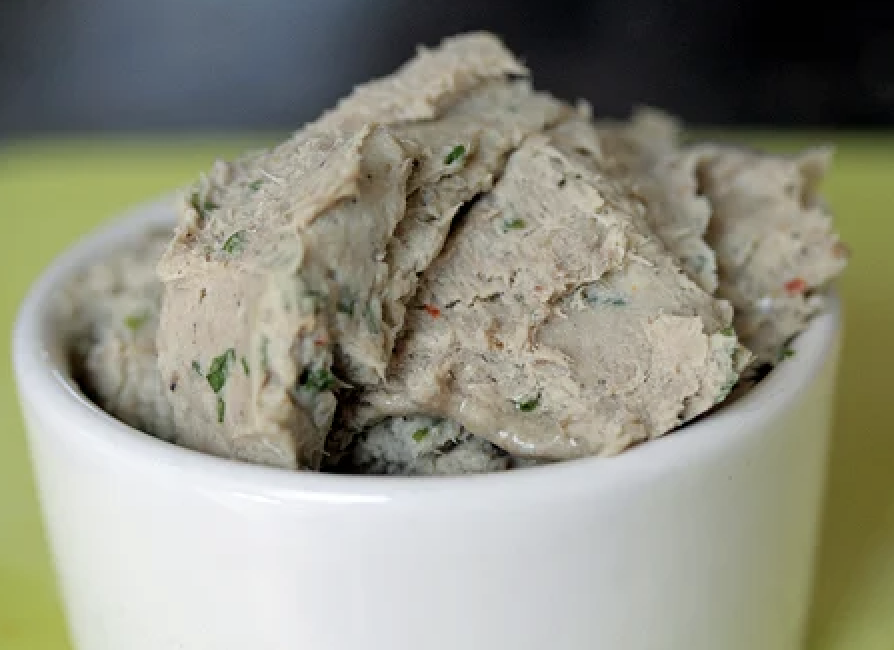
This past week I ran across a recipe that piqued my curiosity. It was for sardine paté. One took a can of sardines, a few other ingredients, tossed them into a blender and blended the very bejabbers out of the contents. What other ingredients, you ask, almost fearing what I will say, since the thought of sardines in a blender has already proved unsettling?

Well, some butter, a hard-boiled egg, lemon juice, capers, mustard, shallots, and parsley, that’s what. The sardines were of the sort that is packed in oil. During the process Robin wandered into the kitchen and idly enquired what I was making. When I told her, her color paled and she quickly found other places in the house to be.

It was obvious that I was on my own here, and shouldn’t expect much help in consuming the gray-brown and fragrant mound that I had created.
This is not the first time in my life that I created food that no one else would eat. When my children were young I found a recipe for liver casserole. There was a bold aroma in the kitchen as it baked, and a finished appearance that most resembled something that the dog had eaten and then later yarked up. Not only would my entire family rise up with one voice and refuse to eat it, but I was not allowed to keep it indoors.

At the time I was puzzled at first. During my own early childhood, liver was a big part of our diet, since organ meats were not subject to rationing during WW II.

I liked it. My family of origin all liked it. My mother had become an expert in its preparation. So for me I was revisiting of one of the pleasant parts of being a kid in the early 1940s.

However, for my kids, the best spin that I can put on the whole casserole episode is that it was as if an alien had brought out something scooped off a greasy floor in the corner of a malodorous room in their UFO. Something whose expiration date was clearly months in the past, and now here it was in the middle of their dinner table and they were being asked to eat it.

‘Twas not exactly the same, but Robin’s facial expression when I spoke the words “sardine paté” did look familiar.

(BTW: the paté is delicious.)

******

Hasten Down the Wind, by Warren Zevon

******

On one of those late summer nights long long ago when too many gin and tonics had definitely clouded my judgment, I had left the front door of my home wide open. At some point I looked up from my chair and saw a bat fluttering about the living room. Interesting, said I to myself, so I stood up and as it flew past me I reached out and caught it in my hand.

As if this were an everyday occurrence I walked serenely to the open doorway and gently tossed the amazed creature out into the dark, whereupon it flew off to tell its story to the rest of the colony.

Apparently it had been too surprised to bite me, because neither of us was harmed in the incident.

******

Hear The Wind Howl, by Leo Kottke

******

A gigantic heat dome is setting up over most of the western US this weekend. What’s a heat dome, you ask? It’s like a monster hair dryer from a beauty salon that has dropped down and lost its mind while being set to parboil. Here’s a graphic to guide you:

It’s the sort of picture that doesn’t need explanation or a legend to tell its story. Records are being broken everywhere you see red. Paradise is right in the middle. I doubt even events like this summer are changing many of the minds over in the conservative bin, many of whom are still describing climate change as a hoax.

Although it is not true that all conservatives are stupid people, it is true that most stupid people are conservative.

John Stuart Mill

Listening to these clodpolls, including some at the highest levels (is there such a thing) of our government is enough to make one ready for a quiet place where you cut out paper dolls and make leather belts.

******

Dust In The Wind, by Kansas

******

Got them ol’ can’t find it blues …

At an AA meeting this past week, I started out using one of my favorite quotations and was dismayed to have it finished for me by another member of the group. Shocking. Impertinent. How dare that addict step on my line? Screwed up my timing and my composure all at once. What was the saying, you ask? It was one that originated in the very early days of Buddhism:

“Before enlightenment, chop wood, carry water. After enlightenment, chop wood, carry water.” 

I asked that modern oracle ChatGPT about it, and got little more than this dry comment:

This proverb carries a profound philosophical lesson. Enlightenment or personal growth does not exempt you from the basic responsibilities and physical realities of human life. The chores, bills, and everyday mundane tasks will always be there. Before enlightenment, you might perform these tasks grudgingly, wishing you were doing something else. After enlightenment, you perform them with total presence, peace, and mindfulness, finding the same value in folding laundry or doing dishes as you would in profound spiritual reflection. 

It was information, but not exactly what I was looking for. So my next stop was an article from Plum Village, the monastery where Thich Nhat Hanh spent the last years of his life, in exile. The title of the piece was HOW TO/ The Zen of Dishwashing. It was lively, witty, and amusing. It was also spot on and my search was ended.

But I now knew that the wisdom expressed in the proverb was not exclusively mine, not if that dimwit across the table from me could quote from it as well. Going to have to use it very sparingly, I thought, and never when he’s at the same meeting.

I am nothing if not petty.

******

I’m Not Feeling It Anymore, by Van Morrison

******

This has been a very windy Spring so far, reminding me of my first few years in South Dakota, where there were long stretches when I couldn’t launch my canoe even on the small lakes around Yankton. I have never loved it when the water would slosh over the gunwales of that boat. I am an okay canoeist, but not a great one. There are definitely times when I should not leave the cabin, but play another few games of solitaire instead of going paddling. I have always tried to be mindful of this acquired wisdom, and it is one of the reasons that I am still alive and here to beguile or bedevil you.

We’ve got a couple of strings of prayer flags out in the back, strung from the ash tree to the board fence. They flutter at the faintest suggestion of a breeze, giving us fair warning about what the day holds and allow us to plan the morning’s activities with accuracy. When the flags stand straight out from the line we do not venture far from home, thus avoiding much spitting out of airborne sand and other grit. (Actually, when the wind blows like that, I don’t even like to think too much about what the air might be carrying and I might be breathing in or swallowing.)

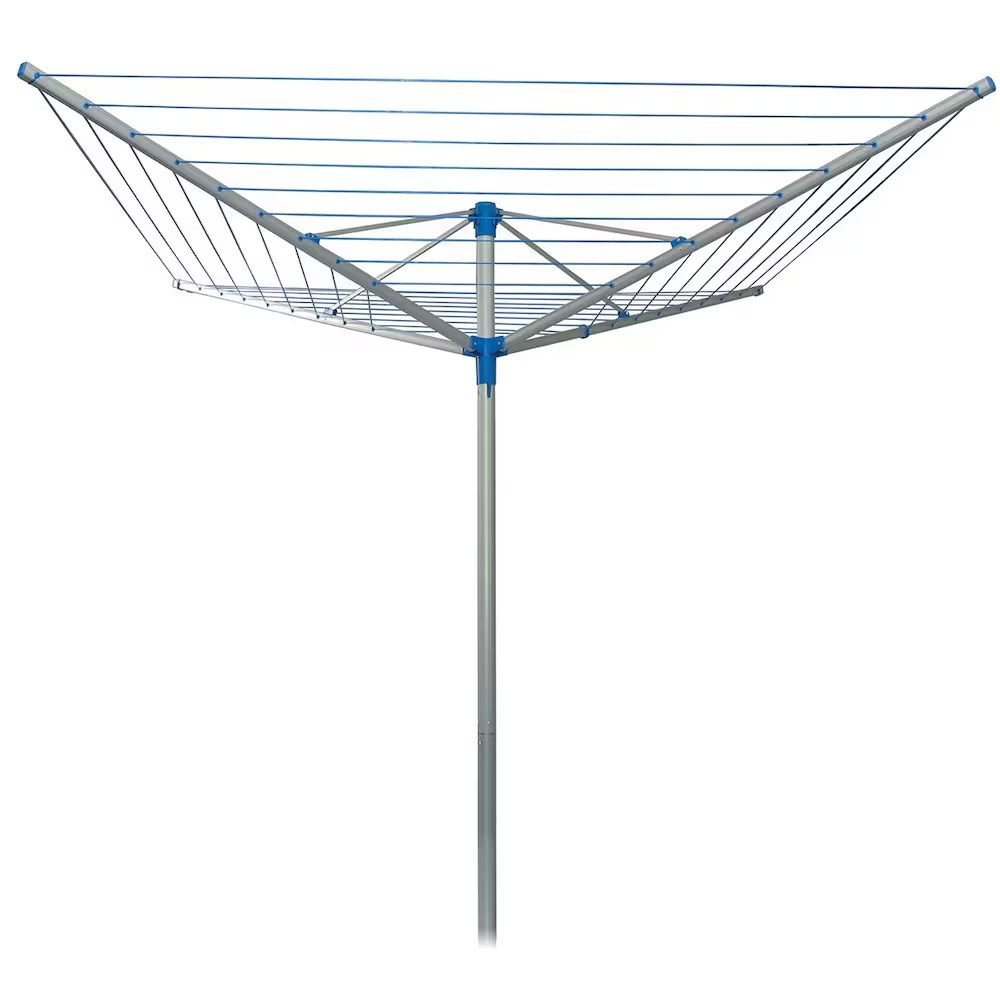
What these blustery days are really good for is drying clothes outdoors. Low humidity and a stiff breeze are nature’s tumble dryer. I put up one of these racks several years ago, and any day it is not raining is fair game for Dame Robin and her sturdy wooden clothespins.

******

******

On Hyndford Street, by Van Morrison

******

A couple of weeks ago, Robin returned from church and opened a conversation that went like this: “You should write down everything you do and where you put everything that’s important in case you die.” It’s the sort of tête-à-tête that senior citizens have from time to time, and while I gave her only one point for tact, I had to award two points for it being a good idea. ‘Twas something I had neglected to do.

Anyway, I am now engaged in writing everything down and placing it in a 3-ring binder. There is no real system that I have for where I put stuff. Sometimes it simply comes down to a space that was available in a drawer in the house or garage and that’s it. Many of those hiding places were so good that even I can’t find them now. God help my descendants.

******

Our drive to Santa Fe from Montrose takes 5 1/2 hours, but from beginning to end it is such a lovely trip that you hardly notice the time passing. Until you stop the car and find that your bottom half is stiff and does not want to get out and go anywhere. The scenery is constantly changing, deserts … mountains … forests … valleys … canyons … it never stops, not until you hit Santa Fe itself when it becomes a less exciting urban landscape. For us the charms of the city are near the Plaza, the oldest part of town.

We first visited this town in 1995, and at that time stayed in a quaint BnB named Inn of the Animal Tracks. It afforded a great room, a short walking distance to the Plaza, was not too costly, and served excellent breakfasts and afternoon teas that were provided by a woman who came in just to cook for us. That’s the good news. The bad news is that today it has become some sort of Urgent Care Center, even the front entrance is greatly altered.

Bah. Humbug.

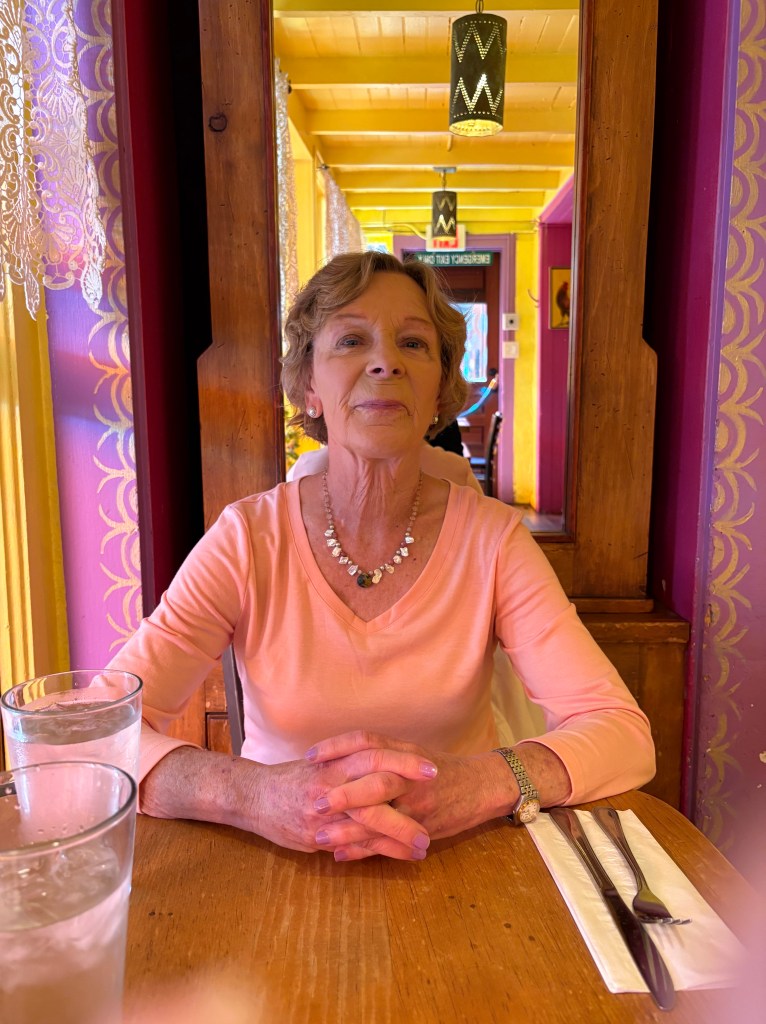
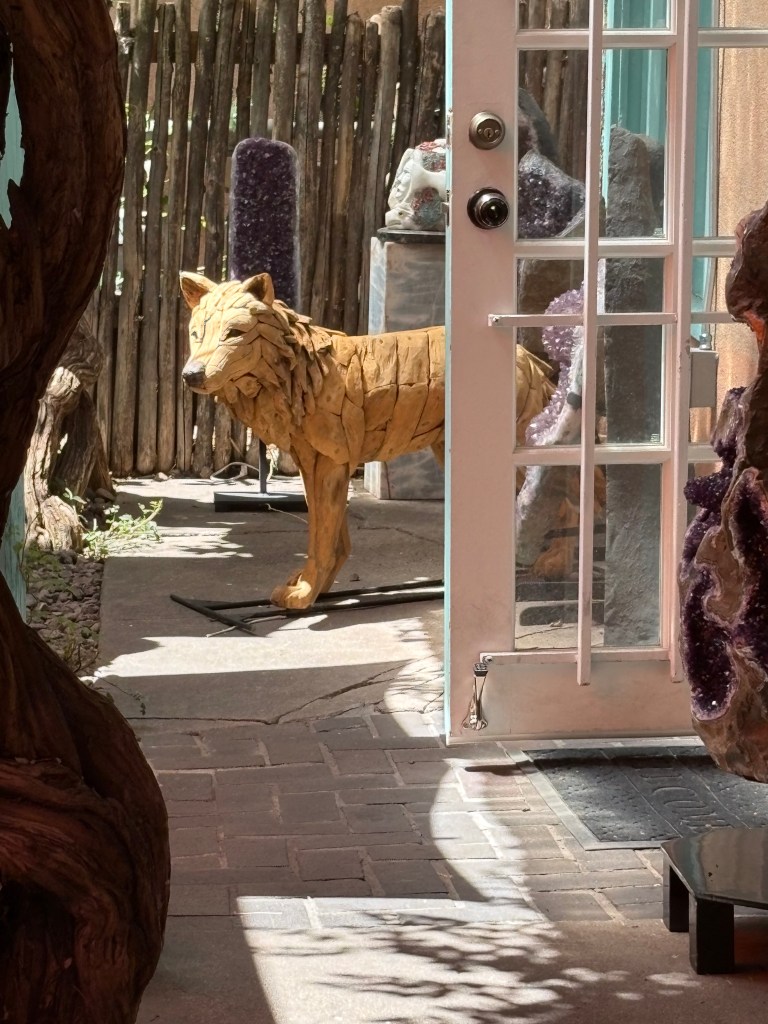
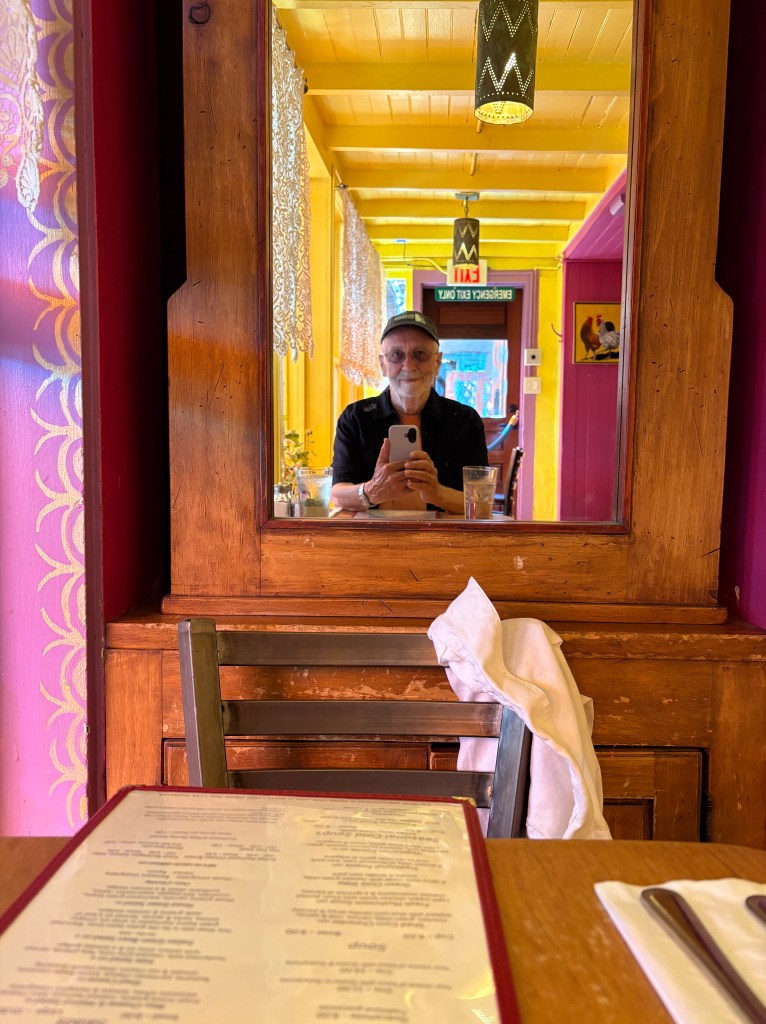
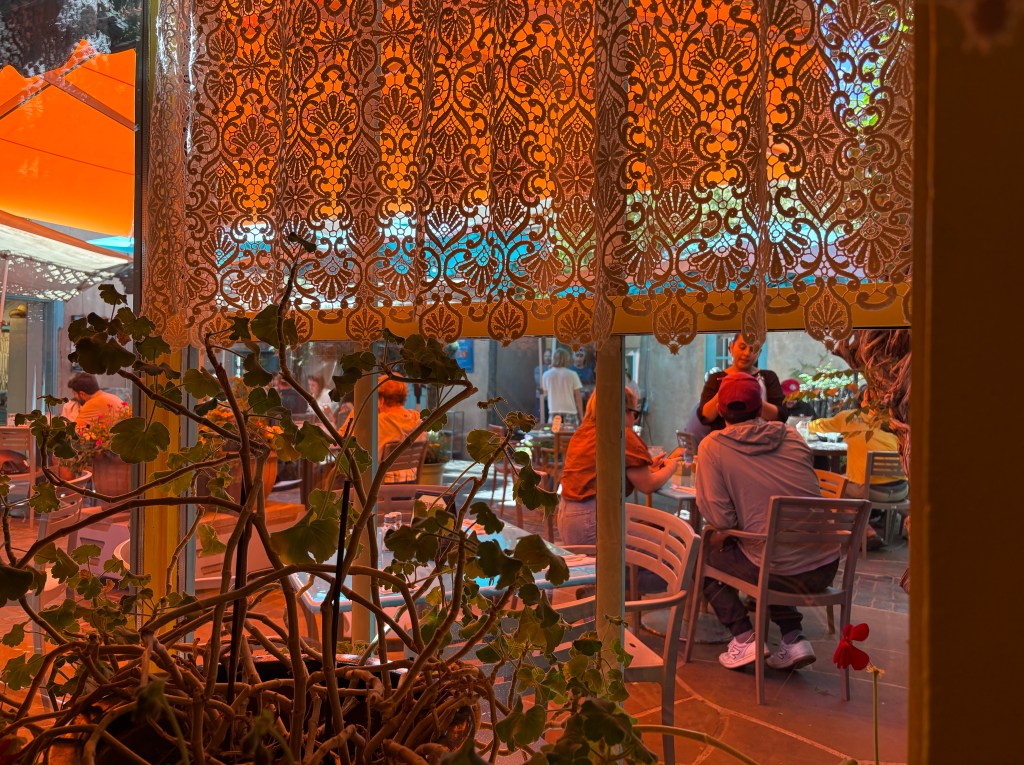
But we did find something that is unchanged from that first trip through Santa Fe, and that is a restaurant named The Shed. The atmosphere is delightful and much of the food was the kind of stuff of the genre that you can’t get back home. I know that something named The Shed sounds a little unpromising but if you take a chance on your next visit here you may like it … a lot. I include a few photos taken there, including one of a life-sized sculpture of a wolf that I couldn’t stop looking at. A startling piece that looked real for a fraction of a second before my brain had time to process it.

******

On Saturday we discovered Museum Hill, where there was so much to be seen and done that I don’t understand how we ever missed it. It’s just a mile and a half from the Plaza, but you do need a map or GPS to find it. At least I did, because it is in the boonies. What’s up there?

  • Museum of Indian Arts & Culture
  • Museum of International Folk Art
  • Wheelwright Museum of the American Indian
  • Museum of Spanish Colonial Art
  • Santa Fe Botanical Garden
  • Milner Plaza Labyrinth

Here are a few children playing in the labyrinth. If you could somehow shoo these critters out of there, walking it would be a serene thing to do.

My excuse for overlooking this wondrous collection art and culture is that Santa Fe has so much to see downtown and around the Plaza area that I never looked elsewhere.

******