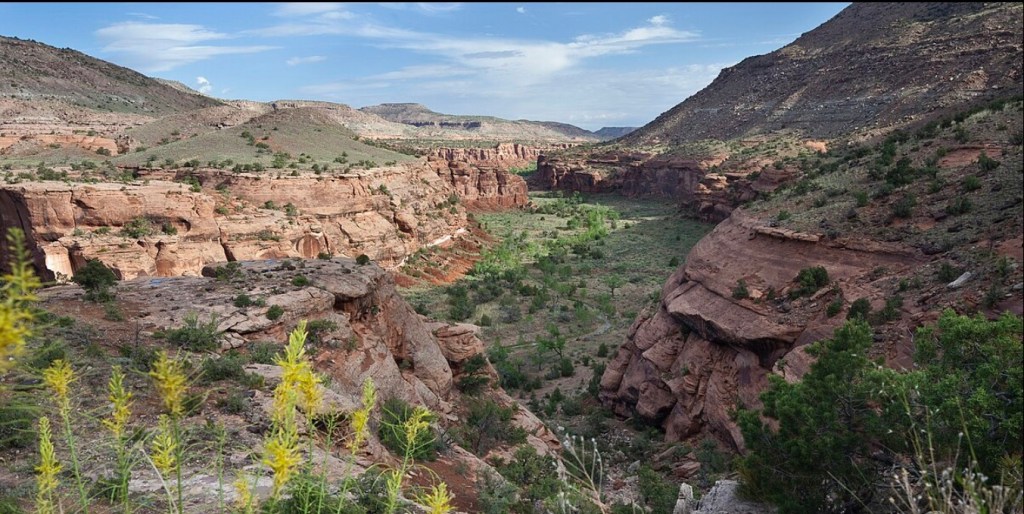
North and west of us about an hour, there is something called Dominguez Canyon, which is a designated wilderness study area. Robin and I have walked up that canyon for perhaps 3 miles on several occasions. Our turnaround destination at those times was a large boulder covered with Native pictographs.
Now we are making plans to go there on a backpacking outing within the next month or so, to get a look at what’s beyond that three mile marker. We’re waiting until the nights are a tad less chilly, which can be an issue in desert areas.
We can only go so far while backpacking because we need to carry along CPAP apparatus and battery. With our present equipment the most we can be out two nights, which is no serious limitation. Our days of doing anything approaching epic trips are far, far behind us. (In fact, my personal physician Dr. Maximosa Aeropuerto has suggested that I remove the word “epic” completely from my vocabulary. Her view is that having it there can only get me in trouble.)
What we do is practice our own form of ultralight camping. This means not bringing along much in the way of cooking/eating gear beyond a coffee pot and a tiny stove. It’s no big deal to eat cold food for a couple of days, and there are so many tasty ready-to-eat choices easily obtainable at any grocery store.
It doesn’t show in the photo above, but that beautiful canyon was carved by Big Dominguez Creek, which ordinarily flows all year, but is vulnerable to drying up in times of drought. Camping when it is running greatly lightens the weight on the traveler’s back, since the only water that needs to be carried is what you need to drink between stops. Water filters range quite a bit in cost, but there are excellent models available for less than thirty dollars that meet our needs and are easy to pack.
******
******
During my years in medicine (which will really not be completely over until that last out-breath) one of my greatest interests has been in the diagnostic process. The steps are outlined classically as such:
- Listen to the patient’s complaint
- Round out the patient’s medical history via a patient exploration through questioning
- Perform an appropriate physical examination
- Compose a list of diagnostic possibilities (differential diagnosis is another term for this)
- If needed, acquire more data through laboratory or radiologic testing, ordering what is needed based on what you have learned
- Formulate your diagnosis and proceed with whatever treatment is indicated
- Be prepared to reconsider your diagnosis if the patient’s therapeutic course is not what you expected.
Part of the fascination that I felt along my professional path was realizing how many variations there are in this scheme. For instance, if your patient comes in complaining of a laceration, the history and physical are abbreviated greatly. The challenge then becomes applying what you know about cleaning the wound, checking for collateral damage, protecting against tetanus, and using what suturing skills you have to close everything up.
On the other hand, if the complaint is I Feel Tired All The Time all of the steps in the list above may need to be followed, perhaps including calling in consultants of one sort or another.
When one became a “seasoned” medical practitioner there was a trap easily fallen into, and that was to make diagnostic jumps, skipping the gathering of details. At that point you tried to shoehorn the patient into what you thought they had until your diagnosis was no longer sustainable. This delay could sometimes be to the patient’s detriment.
A man named Shunryu Suzuki wrote a book called Zen Mind, Beginner’s Mind, which was fist published in 1970. The first statement on the first page has become justifiably famous:
In the beginner’s mind there are many possibilities, but in the expert’s there are few.
When I first ran across this very wise statement I got it wrong. I thought, well of course the medical student always comes up with a differential diagnosis that is way too long, while I, the wiser instructor, can come up with a much shorter list and go right to the heart of the problem.
But what Suzuki was really saying was quite different. In the example above the trap for the student might be to get lost in the too-long list. But at least the true diagnosis is probably in there somewhere. The trap for the teacher is to leave too many things off, and thereby waste valuable time before when mistakes are made and they need to get back on track.
Suzuki’s tells us to keep an open mind, always. To see things as they are rather than what we want them to be, without applying labels or preconceived notions.
I tried to apply this aphorism to my professional and personal lives for decades now, with mixed success. Unfortunately I am still far too skilled in preconceived notions and labeling. My keeping the mind open muscles need constant exercising.

I find that I am closer to the truth of this sign I first read in a Minnesota bar as a younger man. Yet another wise and pithy saying, but this time with the scent of stale beer included.
******
 Little Home In The Valley